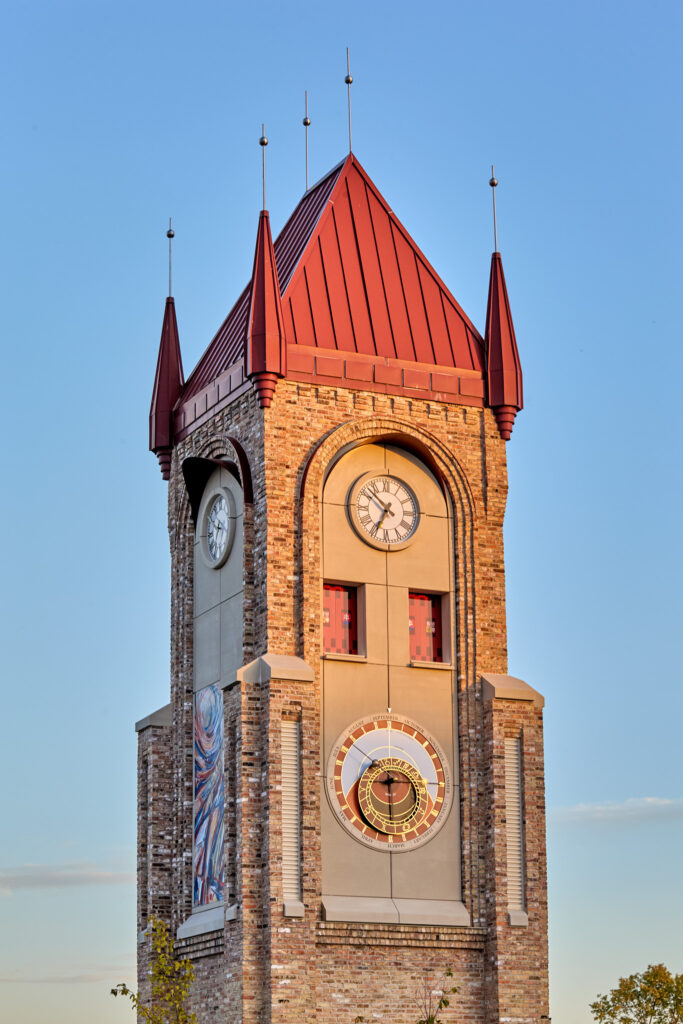
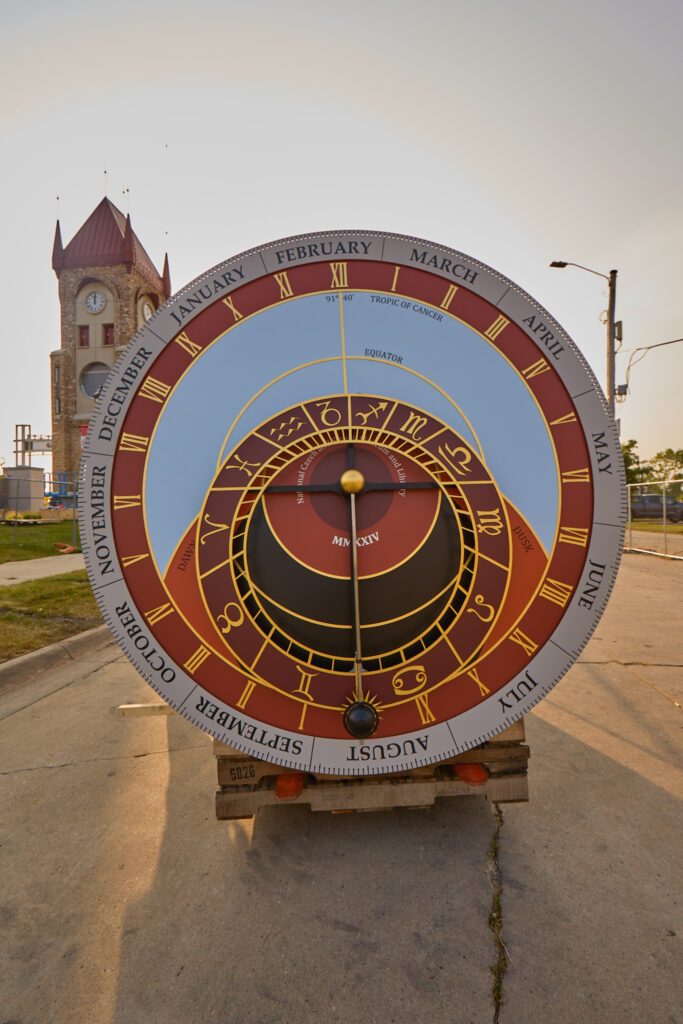
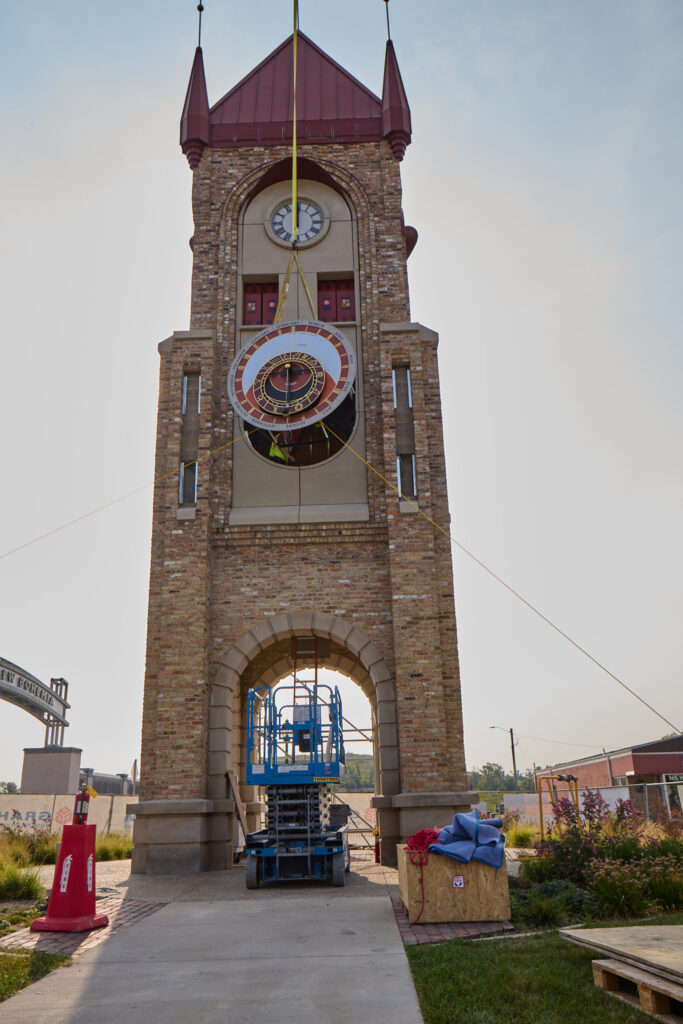
Fabricated by the same team behind the NCSML Orloj, SPEL Company, with close collaboration with NCSML partners Neumann Monson Architects and Graham Construction, the sundial adorns the 16th Avenue face of the tower, beneath the Czechoslovak wolfdog sculpture. Gilded with 24-karat gold, as is the case of the Orloj astrolabe graphics (numbers, lines, and symbols), the sundial will tell the time of day when direct sunlight shines by the apparent position of the sun in the sky. The horological device consists of a dial and a gnomon, which casts a shadow onto the dial.
Sundials belong among the earliest types of timekeeping devices; they were popular for centuries and continue to be important means functionally and decoratively.
The time is determined by the position of the shadow of the diagonal stick between the hour lines. A sundial can only tell the time when the sun is shining on the wall. For this wall, it is in the maximum range of 5 to 14:30 hours.
The sundial indicates the true local time. This differs from the standard CST time. This is because the movement of the Earth is not regular. The reading from the sundial must be corrected using a graph. The Cedar Rapids habitat is not located on the mid-meridian of the time zone, and therefore the time variation due to the influence of longitude is included in the time correction. The blue area corresponds to the period when the sundial is delayed. To determine the CST time from the time read on the sundial, we have to add the number of minutes for the day according to the graph. The biggest time deviation occurs on February 11, when the sundial is delayed by about 21 minutes (it shows about 21 minutes less) and we have to add 21 minutes. On the other hand, on November 3rd, the clock is about 10 minutes ahead of CST (it shows about 10 minutes more) and therefore we have to subtract 10 minutes. During the period of summer time, we have to add an extra 1 hour.
From the position of the shadow of the ball placed on the stick, the calendar period can be approximately determined. The shadow of the ball falls into the calendar marked in dark blue. It draws calendar lines for entering the zodiacal sign. The relevant signs are marked with zodiac symbols. The upper hyperbola corresponds to the winter solstice (Capricorn sign). The line in the middle of the calendar corresponds to the equinoxes (Aries in spring, Libra in autumn). The lower hyperbola corresponds to the summer solstice (the sign of Cancer).