
At the opening reception for the National Czech & Slovak Museum & Library exhibit, Tomáš Garrigue Masaryk and His Family: Memories & Letters, Dr. Martin Palouš provided brief remarks excerpted from the following composition.
Dr. Martin Palouš Speech: May 1, 2025
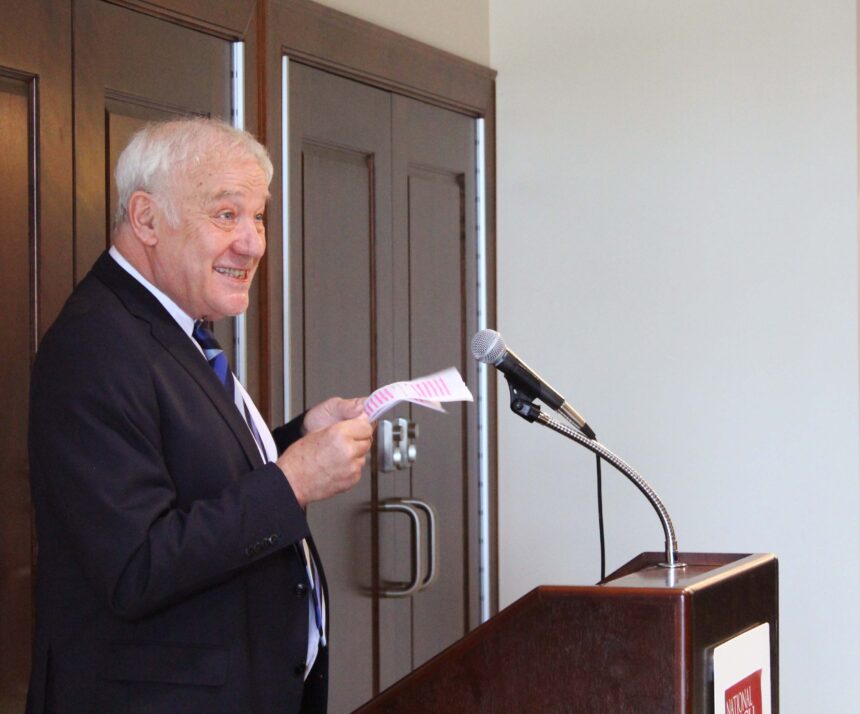
Dr. Martin Palouš, Senior Fellow at the School of International and Public Affairs at Florida International University in Miami, Former Ambassador of the Czech Republic to the United Nations and Former Ambassador of the Czech Republic to the United States
I
Tomas Garrigue Masaryk and his efforts to perceive the Czech Question in “worldly terms”
Who was he?
Tomas Garrigue Masaryk (1850-1937) was a university professor who got involved in all major political debates of his time; a man who exhorted Czechs to think about themselves, their politics, and their national identity in “worldly terms;”
- He spoke openly against the fabricated Czech mythologies and false self-illusions.
- He strongly defended the rights of women and struggled against anti-Semitism.
- He married an American and had strong personal, academic and political ties with the United States.
- He became in the first president of modern democratic Czechoslovak state.
II
Austro-Slavism abandoned
Austro-Slavism was an ideological program of the Slavs under Habsburg rule regarded the Austrian empire as the optimum political framework for the existence of the Slav peoples of Central Europe. Throughout the 19th century – from Vienna Congress 1814/1815 to the revolutionary Spring of Nations of 1848; from 1848 to Austro-Hungarian “Settlement” (the creation of Dual Empire) in 1867; from 1867 to the outbreak of the WWI in 1914) – all Czech mainstream politicians, both conservative (Palacký, Rieger) and liberal “progressive” politicians (Havlíček, Masaryk), believed that the existence of Austrian (and later Austro-Hungarian) state is in the Czech “national interest” and the idea of its dismemberment and creation of an independent Slav state was simply out of question.
III
The outbreak of the “Great War” and the Masaryk’s “progressive philosophy” of history:
The reasons why Masaryk decided in the fall of 1914 to abandon the political doctrine of “Austro-Slavism” and started his campaign for Czechoslovak independence are worth mentioning: Masaryk’s political deeds and actions were always inspired by his philosophy. As true philosopher Masaryk did not see the flow of current international events just in terms of power and “Realpolitik.” He perceived them through the lens of his “ideas” – in the context of universal history unfolding in the transition from the 19th to the 20th century.
For him, the war that had started after the assassination of Archduke Ferdinand d’Este, in Sarajevo on June 28, 1914, and spread quickly all over the world, was manifestation of a deep, endemic conflict between two opposing principles of social organization of modern mankind: between “reactionary” theocracy and “progressive” democracy. The contending geostrategic ambitions of different powers might be clashing on the battlefields, but far more was at stake: the whole spirit of relations between nations; the principles that would dominate human affairs in the future.
A revolution like one that had given birth to the United States and established in the last decades of the 18th century on the territory of the British colonies a “New World Order”, (Novus Ordo Seclorum), burst out on now the old continent. A “New Europe”, a Europe of free, democratically governed nations was striving to defend her cause against the traditional European order that had been created by the power politics of theocracies. Masaryk saw in the war that burst out in 1914 the “world revolution.”
“The history of Europe since the eighteenth century,” wrote Masaryk in a seminal essay “New Europe” sent as a background material to the participants of the Paris Peace Conference in the first half of 1919 – the aim of which was nothing lesser than the creation of a new world order – that precisely reflected the dominant and unambiguously optimistic spirit of the time,
…proves that given their democratic freedom, small peoples can gain independence. The world war was the climax of the movement begun by the French revolution, a movement that liberated one oppressed nation after another. And now there is a chance for a democratic Europe and for freedom and independence of all her nations. [1]
IV
The origins of Czechoslovak relations with the United States
No surprise that such an intellectual approach to politics brought Masaryk’s “foreign action” close to another visionary, who was not just an “idealist” limited by his affiliation with a small nation, but was endowed with a real, and, indeed, robust political power: the American president Woodrow Wilson. The Wilson’s assertion from the spring of 1917 that the United States did need to go to war in order that the world “be made safe for democracy, and his famous “Fourteen Points Address” at the joint session of the US Congress on January 8, 1918 – stating among other:
The peoples of Austria-Hungary, whose place among the nations we wish to see safeguarded and assured, should be accorded the freest opportunity to autonomous development” (the point 10)
and further on
a general association of nations must be formed under specific covenants for the purpose of affording mutual guarantees of political independence and territorial integrity to great and small states alike” (the point 14)
All of that had to sound like sweet music in Masaryk’s ears. It was in fact the most authoritative confirmation of the rectitude of the solution of “Czech Question” for the 20th century he himself was relentlessly working for; a clear signal that the Czechs and Slovaks were taking the right decision on this critical historical juncture; that their desire to gain independence after the three dark centuries of enslavement under the Habsburgs would be finally heard by the powers-to-be, and realized.
V
Is there any significant difference in Czech and Slovak perception and practice of democracy in comparison with democracy as it is perceived and practiced in the United States?
The answer is ambiguous. On the one hand, Central Europeans subscribe to the same basic democratic values and ideas as Americans.
On the other hand, however, there are fundamental differences between political identities and corresponding political behavior of small nations being at home at landlocked countries at the “heart of Europe”, living in the middle of the “old continent” – and of the great American nation inhabiting the mass of land stretched “from coast to coast”, whose predecessors had courage to leave their homes behind and put off on a long journey over the ocean to build ”Shining City upon a Hill”; and later to lay the foundations of free republic in “New World”; to start a global exceptional project, Novus Ordo Seclorum depicted on each single, one dollar bill we have in our wallet and a project conceived as a new opportunity not only for those who were arriving to America from the ”old” European continent behind, but for the whole global community of suffering mankind!
VI
Who are we? Where are we coming from? What is our historical identity?
The answer is paradoxical. Looking back, one can say that our history in Central Europe happens twice. First, we have historical events, all what really happened in the past, all historical materials to be studied and objectively (sine ira at studio) described. Its second live begins when modern national historians start using it politically, as the basic source of our national identity, the point of departure of Czech and Slovak national emancipation program a.
The thing is that it was them (and among them František Palacký, the founding father of modern Czech historiography in the 19th century) who played a key role in the moment of modern Czech nation’s formation, because his concept of Czech history which started in the Czech glorious past, went through a number of crossroads and has imposed on us living the burden of our present situation was used as a basic tool for the nation’s self-understanding and basic orientation in the current world; as a kind of shield to defend its national identity (national pride) and eventually cover up or explain away the foolishness of some of its current political decisions or actions.
The modern Czech nation has come into existence in the transition from the 18th to the 19th century as a “by-product” of modernization efforts of absolutist Austrian state; as a reaction of the people inhabiting the historical Czech lands to the “progressive” policies of its current aristocratic German-speaking rulers. It is a nation “re-born from below”
The endemic problem of Czech democratic politics following from this specific birth-certificate: “smallness” – confronted with the “greatness” of its past. The result is egalitarianism as natural feature of modern Czech national life, but also the absence of aristocratic spirit; the irresistible tendency to mediocrity and the urgent need to overcome it – especially in the moment of crises – by some specific Czech form of “greatness” – looking for the inspiration first in the illustrious examples from the “great” Czech history.
As put succinctly by the most important Czech philosopher of the 20th century Jan Patočka in a personal letter written in the end of the 1960s to a German woman, his very close friend, who was seriously considering moving from Germany to Prague and share with him a historical ordeal of Czechs and Slovaks after the failed Prague Spring of 1968):
The Czechs are a nation of liberated servants. They did not liberate themselves. They did not carry out any great revolution such as that which brought the great American republic into existence. Nor did they experience anything similar to the French Revolution. Rather, they were liberated by an act of emperor. [2]
It is exactly this form of liberation – being liberated and not to liberate themselves, the “re-birth” of Czechs “from below” that makes them as a modern political nation – formulating and pursuing its political program with the central aim of political emancipation – naturally apt to democracy.
Looking at the history of the 19th century, the Czech achievements in the process of modernization were quite impressive. The main feature of the Czech national behavior was a patient but steady progress in the building of civil society. This strategy had a telling name within the Czech political discourse of these times: drobečková politika, “policies of small crumbs”, which could be translated as “small aims, small gains” …
In the last decades of the nineteenth century, the Czech lands were a developed industrial society with strong middle class, a quite impressive educational system and a very active associational life. Czech politicians traditionally had all sorts of complaints as far as the centralist policies of the government in Vienna, or the sometimes more and sometimes less oppressive strategies of Austrian secret police mercilessly hunting down Czech radical and nationalists, but among themselves they certainly got used to and were enjoying their own kind of “democracy.”
The Czech endemic smallness here, as Patocka put it, does not only describe the lack of resources and the disadvantage that results from small numbers, but a kind of “quality,” substantively influencing political behavior. This behavior is always threatened by its own tendency towards closeness, parochialism, opportunism, lack of confidence, and at the same time its permanent need for self-excuse and self-defense.
As “smallness” represents an inherent feature of modern Czech political life there always have been outstanding individuals in the Czech national environment who have desperately tried to open the windows to the outside world and invite a fresh breeze into the somewhat airless environment and to shake the modern Czechs out of their “shells”. Czech smallness has always required – as it does today! – to be compensated by a dose of greatness or worldliness.
It is the fundamental necessary condition, if those who were born from below wanted to succeed in their project of national emancipation in Central Europe (given the history and geostrategic importance of this region).
VII
Czechs and Slovaks
There is one important element that must not be omitted in this context. Modern Czechs were not alone in the region with a complicated history depicted in the old maps as the “heart of Europe”. There always were other both small and medium-sized, both Slavonic and non-Slavonic, nations participating in their historical transformations. Among them there is a nation that has always been so close to Czechs that the idea of political unification with them in one DEMOS in an independent nation-state was accepted as the only possible solution by their leaders in the middle of the “Great War”: Slovaks.
Despite their indisputable like-mindedness of modern Czechs and Slovak that made such arrangement a real possibility when the postwar world order was being built in Paris in 1919, however, there were serious differences here, too.
Whereas the Czechs had shared historical space with the Germans over the centuries, and permanent intercourse with the German element represented a principal theme in their history, the Slovaks had been living in the territories of the Hungarian Empire and their principal partners (and eventual adversaries) in the political process were historically the Hungarians. And whereas Bohemia (the lands of the Czech Crown) belonged to the most developed, industrial regions of Austrian Empire, Slovakia was rural and very little industrialized. In its spirit and character Czech culture reflected the mentality of the 19th century urban middle class. Slovak cultural identity stemmed from the peasantry – most of the population. (The ruling class and aristocracy in Slovakia were Hungarians; the urban population was predominantly German.)
In contrast to Czech secularism, Slovak national culture was religious and deeply devoted to traditional, conservative values. Yet the Slovak nation was very young and had no long history of Czech proportions. Nothing in memory of the emergent Slovak political mind compared to the “glorious past” of the mighty Czech Kingdom or to the great “Hussite Revolution.” Territorial patriotism, which in Bohemia had preceded a Czech-language-oriented national revival in the 19th century, was practically unknown in Slovakia. Until the modern, romantic “Harderian” concept of nation took root there in reaction to the centralizing efforts of enlightened absolutist rulers who attempted to “Hungarize” the Slavonic population, no recognizable Slovak program existed to oppose the idea of the Hungarian state or formulate specifically Slovak demands.
When the “Austro-Hungarian Settlement” of 1867 left the political aspirations of the Slavonic nations of the Empire unsatisfied, the standing of Czech Lands, strong both economically and culturally, did not change very much. But owing to the political invigoration of Hungary conditions in Slovakia deteriorated dramatically. Fearing “panslavism,” the government in Budapest so intensified “Hungarization” that by the opening of the 20th century the fundamental political question in Slovakia was not, as in Bohemia, the decentralization of government and political emancipation, but rather the cultural survival of the Slovak nation.
Thus, when Slovak leaders during and after WWI supported and actively promoted the creation of the Czechoslovak state, they were motivated entirely differently than their Czech counterparts. In contradistinction to the “idealistic” self-understanding of the Czech political cause, which espoused the overarching concept of “world revolution,” Slovak interests were defined in more “realistic” terms of the bare existence of the nation, of sheer national self-preservation.
Though Czechs and Slovaks had much in common from a long tradition of geographic closeness and intercommunication, some basic features of their political behavior -stemming from their mentality, culture, religious feelings, historical experiences, and, maybe first socioeconomic situation – introduced certain tensions into the new Czechoslovak state from the outset.
Czechs became the dominant element in the new Czechoslovak society; played in it the role of an older, more experienced, more knowledgeable, and stronger brother; and always emphasized, in the spirit of their “idealistic” understanding of politics, the importance of unity and state formation in the political nation of Czechoslovakia. Slovaks – assuming the role of younger and, in all respects, weaker brother – continued to stand for the preservation of their specific national (in the ethnic sense) identity.
VIII
Masaryk triumphant
Masaryk’s “foreign action” turned out to be a spectacular success. The organs of an emerging Czechoslovak state were recognized already before the formal end of the war during 1918 by the key allies (France, the United Kingdom, the United States, Italy and Japan). Four years after he had left his country, Masaryk was returning home before the Christmas of 1918 as a national hero, the founding-father of modern Czechoslovak political nation and the first president of its independent and democratic state. His Czechoslovakia became the “favorite child” of the Paris “peacemakers” and her borders were confirmed by the system of peace treaties. The most distinguished of my predecessors opened his first speech with a quotation from the great Czech educator Komenský whose international mission during the Thirty Years War between Catholics and Protestants (1618-1648), the aim of which was to return government in the Czech lands to the hands of Czech people failed.
I firmly trust in God that after the tempests of wrath brought upon our heads by our sins have passed over, the government of thy commonwealth will return to thee, oh Czech people.
And after he pronounced this old prayer, he continued:
The times through which the Czechoslovak nation is passing seem like a fairy tale. But the fairy tale is a reality. The whole world was divided into two camps; after a terrible fight, victory was gained by those who defended the ideals of justice; the idealists won. Autocracy which claimed that sovereigns ruled by divine grace was defeated by democracy resting on the principles of humanitarian society. Prussian militarism was vanquished by popular armies which had first to be organized during the war. Allies, faithful to democracy, declared for the rights of all states and nations, the small as well as the great, to independence. Against the four Central Powers the whole of mankind united. And if the consensus of nations could be used as an argument for the existence of God, then the consensus of all nations of the world in this war is proof of the truth of democracy.
IX
In Conclusion: The Presence of the Past. The Task, Masaryk Left for Us: Just to Step into his Shoes or to Think Through and Examine Critically His Legacy?
But as we all know, history didn’t stop at this moment and went on and on. Our fate in the 20th century was somewhat different than those who wanted to make the world safe for democracy expected and were ready to work hard at the “heart of Europe” to turn the Masaryk’s vision into reality. It is still in 2025, i.e., one hundred and seven years later, an unfinished task and we all, Czech and Slovak citizens, but also you Czech Americans and Slovak Americans, must keep asking what we can do ourselves for our freedom and democracy.
I will conclude by a short quote from New Year Address of Václav Havel pronounced on January 1, 1990, and let’s all take it as an appeal to remember what our spiritual and political tradition is and to act accordingly:
The most distinguished of my predecessors opened his first speech with a quotation from the great Czech educator Komenský. Allow me to conclude my first speech with my own paraphrase of the same statement:
People, your government has returned to you!
It sounds nice, doesn’t it? But the question remains: how to understand and articulate) politically the principal difference between the beginning and the end of the “short 20th century? What was the principal challenge for Vaclav Havel when he appeared, also miraculously at the Prague Castle and was to accept and critically think through the Tomas Garrigue Masaryk’s legacy?
[1] New Europe
[2] Decrees of Emperor Joseph II Habsburg issued right after he got to power in 1781
Vaclav Havel’s Legacy and Trans-Atlantic Relations in 2025
I
With the new US administration trans-Atlantic relations are finding themselves in the process of radical transformation. The whole system of international relations created after WWII is disappearing, everything seems to be in flux, the East-West division is being replaced by complex global relations between the states, big and small, belonging either to the West” or to the “rest”. My intention is to look at the situation of the world in 2025 from the Czech perspective and bring into the current debate Vaclav Havel’s legacy.
The point of departure: transatlantic relations have entered a period of renewed complexity. The post–World War II system of global governance appears to be undergoing significant reconfiguration, as traditional East–West divisions give way to a more complex, multipolar landscape. In this lecture, these developments will be examined through the lens of Václav Havel’s legacy, whose vision of moral responsibility, human rights, and transatlantic cooperation offers a compelling framework for understanding today’s international relations.
II
When a Playwright Is Turned into a Philosopher-King
In his review of Patočka’s “Co jsou Češi? Was sind die Tschechen?“ published in the Times Literary Supplement in 1993, Ernest Gellner, wrote:
The pre-war Czechoslovakia founded by Masaryk inherited in a way his „professorial“ qualities. But it happened, in the course of the complicated history of the 20th century, in which its inhabitants repeatedly lost their freedom, that „professors“ simply run out. So when finally a new opportunity came for their liberation, they had to be satisfied with a playwright.[1]
The life-story of Vaclav Havel, who was elevated – unexpectedly and all of a sudden – by the Velvet Revolution of 1989 to the position of Czech „philosopher-king“, and especially his deep personal relationship with Patočka we will now focus on, demonstrates clearly, in my view, that this remark, most likely meant like a friendly nudge, contained actually a much deeper observation. How did these two – a philosopher and playwright – meet? What did this encounter mean for them? What did they have in common? How did Patočka influence Havel’s own approach to the „Czech question“ and his political vision for the future, a vision he started to promote and implement, immediately after he was elected the head of state at the moment of its return from its previous position of Soviet satellite into the family of free European nations? What kind of philosophy of history can be found here, inspiring and directing all his practical efforts, before and after 1989? Did Vaclav Havel change, when he stopped being a dissident and became president and thus stepping into the shoes originally worn by Masaryk? Did he also succumbed to the trap of being perceived as „victorious authority“, or did he manage to face up successfully what Patočka named as „its flip side“?[2]
According to his own words, Havel got his hands on Patočka first book Natural World as a Political Problem, brought to him by a friend who had access to the special collection of publications in the Prague University Library that were not normally accessible at that time for the general public, when he was sixteen years old; he read it through in one sitting – a difficult for me to imagine – from beginning to end. As a teenager born into a „bourgeois“ family, he felt little like a stranger in the world where the „classless“ society was just being built and the socialist ideals were turned into reality by the methods of „enhanced class struggle.“ With this personal imprint and looking for his own way through life, he liked to discover the hidden layers of Czech cultural traditions still existing in the 1950s somewhere under the surface of the overwhelming societal transformations. His first reading of somewhat arcane text of a Prague phenomenologist apparently confirmed to him that it was a right choice. Since then, Havel didn’t miss any opportunity to get acquainted with any text of Patočka he happened to come across.
In the „Golden Sixties“, when thanks to „the thaw“, Czech society started slowly to rediscover its ideologically suppressed identity and return to the creative sources of its national spirit – with its complicated and often troubled history and permanently struggle with Czech „smallness“ – Havel and Patočka met for the first time face to face, in the theatre On the Balustrade, where Havel got an opportunity not only to read Patočka, but to listen to him and observe in person his philosophical „inner actions“ : impromptu lectures in the theater bar after the performances, for an audience usually composed of actors and other theater employees, including the stage personnel. A kind of silent dialogue between them was initiated on these occasions and Havel started to realize what actually brought his fascination with the dramatic art that just was becoming his life-long vocation together with Patočka’s relation to philosophy: a theater play – a „study of the human soul in the moment of dramatic action,“ in the words of Voegelin[3] – and Patočka’s relentless philosophizing had common ground: they both had capacity to be socially effective and change, at least for a moment, the minds and hearts of those who were exposed to their miraculous influence.
The communication between Patočka and Havel continued – most likely involving a growing number of more actual, political themes – during the years of crisis 1968/1969, but it was only the period of normalization in the 1970s that brought them closer and closer together and their rapprochement culminated in their joint action when they both accepted, together with Jiri Hajek, the former minister for foreign affairs, the difficult role of spokespersons of Charter 77.
The first step on this road was that both articulated, each of them in his specific way, but in principle the same position, as far as the current political situation in the country. Whereas playwright Havel wrote his open letter to Dr. Husák, which quickly became a significant catalyst in the nascent independent public space that was to make its full appearance at the moment of publication of the Charter Manifesto at the beginning of January 1977, Patočka expressed his view on Husák‘s regime to his own usual audience, i.e. his “philosophical circle.”
Here is how he characterized it – in full agreement with Havel’s analysis (that was written only two years later!) -, in his opening lecture of home-seminar “Plato and Europe”, already mentioned above. The political regime currently in place in Czechoslovakia represented, in his words, a sheer
human machinery of decline and degeneration, the basic aim of which was to extinguish in advance the smallest glimmer of mobilizable social initiative…to deprive the society entirely, or almost entirely, of its moral strength,
nonetheless allowing at the same time]
its external physical capacities…to grow;” using as its basic method of governance “fear, disorientation, wiles of comfort, possibility to gain advantages in the environment of general scarcity, creating here an artificially interconnected complex of motivations….[4]
It was exactly here, where the Patočka’s idea of philosophy and the Havel’s idea of theater met – offering all their spiritual energy and persuasive power they were endowed with thanks to their unique talents, to the service of a concrete human community finding itself in a difficult existential situation – and their mutual interference resulted in the end in their joint act of open civic resistance.
And finally, the last encounter between Havel and Patočka, described in the Havel’s short text written in the spring of 1977 in Ruzyně Prison, where Havel was held in detention, investigated for the alleged „subversion of republic in connection with foreign powers“, used as the main source of information in this chapter.[5] It had taken place in the second week of January of that year, in the waiting room for the interrogated persons of the same state facility. The three fresh Charter 77 spokespersons – Patočka, Havel and Jiří Hájek – were sitting there, waiting for their turn, and were „philosophizing“. Their conversation could have been interrupted in any moment by their interrogators, but
professor Patočka seemed to be utterly undisturbed by this fact: in an improvised seminary on the history of idea of human immortality and human responsibility, he weighted words with the same care and prudence, as if they had had unlimited amount of time for it.[6]
Havel didn’t feel himself at that moment – as he had felt many times in the Patočka’s presence in the past, like a student whose only role was just to listen his professor and eventually take notes of what was said by him. He realized that at that moment he became an equal partner in a real philosophical dialogue. Patočka was visibly animated by this fact, too, and invited Havel to come to see him at home in the near future, so that they could continue in their conversation. Havel gladly accepted his invitation and wished to pay Patočka his visit as soon as possible, in the best case in the evening of the same day. But this proposed visit never took place. Havel was detained after his interrogation that day and returned home only four and half months later. Patočka passed away in mid March, having suffered stroke in the hospital where he ended, exhausted after a series of whole day-long police interrogations.
After the Patočka’s death, their dialogue had obviously to take a different form, but it was never terminated, Patočka becoming only a silent partner in it. Released from prison in late May of 1977 and before being imprisoned again two years later (this time spending there more than four years in jail), Havel had an opportunity to read (and I am sure he really did), all the Patočka’s last texts devoted to his Charter 77 activities. As his response, he himself wrote his most known essay Power of the Powerless that was dedicated to Patočka’s memory. And the silent dialogue between Havel and his philosophical teacher went on and on – Havel being in and out of jail -, and its traces can be found somewhere behind all his writings in the years to come.
The background for all Havel’s contributions to it was the “parallel polis” of Charter 77 – a small, but open, dynamic human community composed of individuals from all walks of life (from the radical left and the conservative right, Catholics, Protestants, Jews, agnostics, adherents of underground, subscribing to no specific religion or worldview) – that refused together to be manipulated by the current holders of power. It was this dissidents’ world, what was the natural basis for the Havel’s originally non-political politics, that was becoming more and more political in the end of the 1980, when his unexpected rise to power begun, and his almost miraculous transformation from the most known Czechoslovak dissident, first to the leader of the Velvet Revolution and then, as its direct consequence, to the position of Czechoslovak and later Czech President took place.
Right after he moved his operation to Prague Castle, Havel started to deliver speeches on various occasions in which he tried to lay out his political program in his new capacity. In conclusion of this passage, I will quote from and comment on two of them: his first New Year’s Address to the Nation, and his address to the Joint Session of the US Congress that was held on February 22, 1990, under the occasion of his first official visit to the United States.
The message sent out was clear: The Masaryk’s spirit, that had come to rule in the Prague Castle in 1918 and then disappeared in the course of the “short” 20th century, – a period in the world history that started with the First World War and ended with the collapse of communism in Europe – was back again with the arrival of a new era.
When listening to Vaclav Havel on January 1, 1990 – after the traditional celebrations of night before, that were most likely especially intensive for the political reasons all over the country this year – the Czechoslovak citizens could easily ask themselves the same rhetorical question raised by Masaryk in his first presidential address to the members of revolutionary National Assembly, a day after his election:
Are we living in a fairy-tale?“, answered immediately „It is all real reality…..the idealists have won, spirit won over matter, right over violence, truth over deviousness.[7]
What they heard from their new president had to sound as very similar in their ears.
The Velvet Revolution brought two important lessons that now, he said, should have been put into the foundations of new democratic Czechoslovak politics:
First of all, people are never just a product of the external world; they are also able to relate themselves to something superior, however systematically, the external world tries to kill that ability in them. Secondly, the humanistic and democratic traditions, about which there had been so much idle talk, did after all slumber in the unconsciousness of our nations and ethnic minorities, and were inconspicuously passed from one generation to another, so that each of us could discover them at the right time and transform them into deeds…[8]
And he went on:
…Masaryk based his politics on morality. Let us try, in a new time and in a new way, to restore this concept of politics. Let us teach ourselves and others that politics should be an expression of a desire to contribute to the happiness of the community rather than of a need to cheat or rape the community. Politics can be not simply the art of the possible, especially if this means the art of speculation, calculation, intrigue, secret deals and pragmatic maneuvering, but that it can also be the art of the impossible, that is, the art of improving ourselves and the world…..
…We are a small country, yet at one time we were the spiritual crossroads of Europe. Is there a reason why we could not again become one? ….Our main enemy today is our own bad traits: indifference to the common good, vanity, personal ambition, selfishness, and rivalry. The main struggle will have to be fought on this field….[9]
And in Washington on the Capitol Hill, he presented again to the assembled senators and representatives who applauded were giving him standing ovations more than twenty times, his basic vision concerning the upcoming politics of transition:
The Communist type of totalitarian system has left both our nations Czechs and Slovaks – as it has all the nations of the Soviet Union, and the other countries Soviet Union subjugated in its time – a legacy of countless dead, an infinite spectrum of human suffering, profound economic decline, and above all enormous human humiliation. It has brought us horrors that fortunately you have not known.
At the same time, however – unintentionally, of course – it has given us something positive: a special capacity to look, from time to time, somewhat further than someone who has not undergone this bitter experience. A person who cannot move and live a normal life because he is pinned under a boulder has more time to think about his hopes than someone who is not trapped in this way.
What I am trying to say is this: We must all learn many things from you, from how to educate our offspring, how to elect our representatives, all the way to how organize our economic life so that it will lead to prosperity and not poverty. But it does not have to be merely assistance from the well-educated, the powerful and the wealthy to someone who has nothing to offer in return.
We too can offer something to you: our experience and the knowledge that has come out of it.[10]
It was natural for the citizens of the liberated Czechoslovak state to look for the inspiration for their way forward in its founding father Masaryk and connect its future with his legacy. The principal point of departure, however, of the current transition can‘t be found – and here is again the voice of Patočka as a Masaryk’s philosophical critic – in the ideas belonging to his progressivist philosophy of history. It must be looked for primarily in the experience of encounter with totalitarianism made only after the Masaryk’s death in the course of the 20th century, and in „the knowledge that has come out of it.“ The current task to bring democracy back, required, for Havel – is not just the ability to adopt the existing liberal model of democratic government to the Czechoslovak condition with all its institutions and to “return to Europe.” It also required the readiness of its citizens to reassume collectively the role of spiritual crossroads of Europe, the Czech lands once were and should be again – in the situation when the Europe’s role as the main civilizational center was over and all her nations were making experience and needed to adjust their policies to the arrival of the “post-European” age.
To sum up:
If one is looking for the spiritual basis of the Havel’s concept of politics of transition from communism – his emphasis on indispensable role of civil society in it, on active policies, both domestic and international, in the area of human rights, on civic education with the main goal to revive the spirit of responsibility for public matters in individual citizens and in raising of general awareness that man qua man must cultivate his/her capability to “transcend” his/her finiteness and exist face-to-face to the Mystery of Being – it is neither a philosophically dressed-up version of progressivism, still present among liberal intellectuals of the West, nor utopianism of some other provenience, fashionable in these days. It is the Patočka’s phenomenological philosophy of history that speaks here out. What is its message through Havel as its messenger? Thanks to him we can be better aware now that the success of a politician cannot be measured only by its concrete temporary political achievements, but by the impact of policies enhanced and implemented by him on the “soul” of his polis – a human collective that today takes form of, but transcends at the same time, the level of nation-state. Thanks to him we can be better ourselves and try not to miss, in the context of our life activities taking place in our concrete place, in our hic et nunc, our own unique opportunity to hear the Nietzsche’s “stillest words” that are invisibly changing the world.
III.
Havel Idealist or Realist?
The best source for understanding Havel’s foreign policy, which was centered on the promotion of human rights both at home and abroad, is undoubtedly his own testimony available in his Talks from Lány, which I recommend to your attention. Knowing that there is no longer time to think about them, neither on my side nor on yours, I would like to offer you, as an example of Havel’s idealistic foreign policy, my attached analysis of one typical of them, his activity on the Cuban question – since the resolution criticizing the state of human rights in Cuba, which the Czech Republic submitted and pushed through at the meeting of the UN Human Rights Commission in Geneva in years 1999, 2000 and 2001, through the activities of the International Committee for Human Rights in Cuba, which was founded on his initiative after the end of his second Czech presidential mandate in 2003 in Prague. It is also important to consider his presidential speeches on this topic on his many foreign trips and VH’s activities within the Prague Crossroads and Forum 2000.
Here is an illustrative list of Havel’s realistic steps. To trace its origins, it is necessary to go back to the very beginning of Havel’s political career.
- That was the famous handshake when, as the leader of the Velvet Revolution, Havel met then Prime Minister Adamec on November 26, 1989 in Prague’s Municipal House, thanks to which the process started by the events of November 17 took on a completely new dynamic.
- It also certainly includes the relationship that Havel had with the Prime Minister of National Understanding, Marián Čalfa, who in the last communist government held the role of deputy prime minister for legislation.
- The first foreign trip of V. H. I was then the head of the foreign commission of the Civic Forum and communication with the MFA apparatus was in its infancy. VH asked me, in cooperation with the German Public Committee, to take it upon myself to prepare a one-day trip to two German states (Berlin and Munich) on January 2, 1990, in order to prevent the first invitation from Moscow, the center of Soviet imperial power, from which, despite the fact that Gorbachev was currently ruling there, we had not been able to get an invitation from Moscow, the center of Soviet imperial power. intended to emancipate themselves in the long term
- Right after that came the famous first trip to the United States in February (it led through Iceland and Canada, which I also prepared as a member of the advance team sent to the USA a week before). It also contained somewhat absurd elements, so typical of Havel’s early period: In addition to the truly gigantic delegation that accompanied the president on this memorable trip, the American ambassador Shirley Temple-Black also traveled with us on the plane, and sometimes other passengers boarded or disembarked …
- Only then did Moscow come into play and an official meeting with Gorbachev in the Kremlin, where VH arrived with two basic themes. The first was the future of the Warsaw Pact, which, according to the Soviet vision, was to be preserved and transformed into one of the institutions of the emerging European House. The Hungarians have previously sent a signal that they intend to leave this military grouping. Havel presented Gorbachev with his proposal that the Warsaw Pact must be dissolved and that everything that such a step entail must be definitively dealt with. The second topic was the departure of Soviet troops, temporarily stationed (this temporariness had already lasted for more than two decades) on our territory. Both of what Havel proposed became reality.
- And finally, a small note about the departure of the troops: I certainly do not intend to deny the merits of Michal Kocab in this matter that is so sensitive for us, but it was not only he who negotiated with the Soviet side (with General Vorobyov). Foreign Minister Jiří Dienstbier entrusted the negotiations to former Deputy Foreign Minister Evžen Vacek (a typical old structure connected not only with the Czechoslovak but also with the Soviet security apparatus), who had maintained personal contacts with Soviet army representatives for years and could now effectively apply them. Vacek was subsequently rewarded for his good services in this matter: he was sent as Czechoslovak Ambassador Extraordinary and Plenipotentiary to Nigeria, and Havel approved his posting as President.
IV
Havel’s involvement in the creation of a new political framework in Europe:
Havel’s perception of other changes, which were certainly not yet anticipated in Paris, which were triggered by the events of 1989. After the triple unification (of language, Germany and Europe, as Ralf Dahrendorf put it in his 1990 seminal book Reflections on the Revolution in Europe: In a letter intended to have been sent to a gentleman in Warsaw – there came a period of fragmentation, new conflicts and new threats. Three federations, the Soviet Union, Yugoslavia and Czechoslovakia, fell apart, and there was a need to respond realistically to these three events and their consequences.
The transformation of European institutions and the emergence of a new political architecture thus received a new impetus, and the President of VH was undoubtedly a visible and internationally recognized player in this process. The number one Czechoslovak foreign policy issue was the relationship, gradual approximation and, in the end, membership in the interconnected institutions of this new European architecture, alongside the OSCE of the Council of Europe, the European Communities, the North Atlantic Treaty Organization, and the OECD.
However, it was not only a strategy to gradually expand the zone of stability and security (within NATO, the principle of common defense in the spirit of Article 4 of the Washington Treaty), but also to find the position of the Alliance in the new world, which required designing its activities outside its framework. The influential US Senator Richard Luger formulated this problem quite clearly in the early 1990s: the NATO has to go out of area or out of business. This is exactly what the GM realistically understood, and he was aware of the commitment and responsibility that the Czech Republic was assuming with its desired future membership.
The transformation of European institutions and the emergence of a new political architecture thus received a new impetus, and the President of VH was undoubtedly a visible and internationally recognized player in this process. The number one Czechoslovak foreign policy issue was the relationship, gradual approximation and, in the end, membership in the interconnected institutions of this new European architecture, alongside the OSCE of the Council of Europe, the European Communities, the North Atlantic Treaty Organization, and the OECD.
However, it was not only a strategy to gradually expand the zone of stability and security (within NATO, the principle of common defense in the spirit of Article 4 of the Washington Treaty), but also to find the position of the Alliance in the new world, which required designing its activities outside its framework. The influential US Senator Richard Luger formulated this problem quite clearly in the early 1990s: NATO has to go out of area or out of business. This is exactly what the GM realistically understood, and he was aware of the commitment and responsibility that the Czech Republic was assuming with its desired future membership.
In the new world, it was necessary not only to define and negotiate a new relationship with Russia, China and other countries in the position of regional powers, but also to create an effective strategy and tools to counter the new threats, terrorism and non-state actors that suddenly emerged in the world with the collapse of a stable bipolar order in the world. What Havel quite realistically considered in promoting his human rights policy was also the global context and regional crises – in the first place the conflict in Yugoslavia and the Middle East.
Here are at least the decisions for which Havel was and still has been harshly criticized by many, but which clearly testify that he was not only an idealistic philosopher-king at Prague Castle, but also a political realist:
- his support for the Czech participation in NATO’s intervention in the former Yugoslavia, which took place a few weeks after we became members of the Alliance in March 1999.
- his other activities towards Kosovo.
- his last act of presidency in international politics, just before the end of his second term, signing a letter from the heads of state of the coalition willing to take part in the US invasion of Iraq in the spring of 2003, pitting old and new Europe against each other.
V
The endemic asymmetry of bilateral relations between Czechoslovakia and later the Czech Republic and the United States:
As a realist, Havel was undoubtedly well aware of this asymmetry, but in his own unique way he tried to symmetrize the CZ-US relationship, to make the state, of which he was president, not only a client of a powerful patron in international relations, but a partner in the dialogue that he himself, from the moment of his first encounter with America in the spring of 1968, through his friends among American artists, his dissident contacts with the U.S. Embassy in the 1980s, his presidential term between 1990 and 2003, and even after he was a presidential pensioner, he intensively and with his own inventiveness continued to develop and promote. There is no doubt that this is an important part of Havel’s presidential legacy, which is protected by his presidential library in Prague, established on the American model, but capable of defending and further developing in its activities what political realists call (it should be noted that Havel himself had a problem with this term) Czech national interests.
VI
Havel’s Legacy in the World of Donald Trump in the Spring of 2025. A Couple of Reflections Made in the First Week of his Second Administration
First of all, Trump was already the US President between 2017 and 2021, lost his bid in 2020, so it was for the third time when we had an opportunity to experience his presidential campaign. When trying to understand and asses realistically his intentions we must take into consideration two things: on the one hand his chaotic, narcisistic and strangely childish personality (demonstrated in his unshakeable belief that the victory in the 2020 elections was “stolen” from him) and on the other hand the state of the world we are living in today, in January of 2025, when he is going to return to the White House.
How his personal qualities will affect his performance as President of the United States? Is he really a strong leader he considers himself to be? Can we expect from him at least some moderation, openmindness, generosity, altruism, and political rationality? Or is he going to be driven in all his decisions and actions just by his rude instincts and emotions? Will the US foreign policies with Donald Trump at helms be guided only by his ever changing wishes and wild arbitrary ideas, or by his realist assessment of American national interests and the basic need to take into consideration their essential continuity?
It is trivial to say that American national interests are determined by the great „constants“ in the American Spirit: the US geography; the Declaration of Independence and Revolutionary War 1775-1783; the process leading to the adoption of US Constitution and its first ten amendments; the course of US history conceived in the 19th century by Americans as their „Manifest Destiny“; the US experiences as the leading democratic power in the world in the 20th century, etc, atc. In short: American national interests always transcend any concrete discussion about them and, for sure, they do not change every four years with the coming of a new administration! .
My advice is to adopt the position of wait and see and not rush too quickly to try to answer all these troubling questions. Trump’s statements are simply “Trumpish”. If they were really meant seriously, this would certainly be a cause for a great concern. Does Trump really want to be a mirror image of the Russian dictator Putin or the Chinese communist leader Xi Jingling?
It is true that both Russia and China show considerable interest in Panama Canal or Greenland. But does it mean that the United States must project its global power in the same way and behave like the mightiest global „imperialist“? Would such a behavior be in line with American political traditions and spirituality? The answer is simple: no!
The danger of schizophrenia in American foreign policy-making is certainly imminent, but it is the responsibility of every sensible diplomat to communicate effectively with his/her American counterparts – as it is the case in their communications with diplomats from all other members of international community of sovereign states, European or non-European, large or small. For now, we can take the news coming from the United States as a part of Trump’s communication strategy, but let’s wait for the practical results his presidential engagement will have. The president of Panama has already responded to the Trump’s statements. His claim to ownership of Panama Canal certainly represents a sensitive issue not only for Panama‘s sovereignty, but for all Latin American states. Denmark has also objected to the Trump’s declared plan concerning Greenland. So the European dimension is added as well. It seems to me that Trump is rather trying to find out what kind of “deal” his provocative pronouncements could ultimately lead to. Expecting only the worst from him, and trying to get by in formulating foreign policies without the United States or against the United States with him at helms would be very unreasonable not only for Latin American and European countries, but for the whole world. We simply have to stay calm and stick to a rational approach in our relations with the United States. I optimistically believe that things may not turn out badly or even catastrophic for us with Donald Trump residing again in the White House.
Trump recently raised the stakes again when he appealed to the European NATO countries to increase their defense spending to five percent of their GDP. The Czech Republic is around two percent now and Czech Prime Minister Fiala has already opened a question whether we should not go to at least three percent, because of the dire and increasingly dangerous security situation in the world. But five percent would probably really be far from the edge! Perhaps this Trump’s message to European NATO member states will lead to sharp exchanges of opinions, but I do not think that any insoluble conflict between Americans and Europeans in this matter is in Trump’s interest. First of all, I ask whether the Trump’s “Make America Great Again” policies means a new version of American isolationism for the 21st century. namely whether the United States will be great again if Trump also in his foreign policies adopts the perspective of many ordinary American citizens– the opinions of folks living somewhere in the countryside, people who traditionally have no interest in the wider world out there, are guided by their strong religious beliefs and for many good reasons despise progressivism so fashionable today.
I am convinced that even with Trump at helms, America is not heading towards a new version of isolationism, because the United States can be great again only as a primary global actor, that is, with proper understanding of international context of all its operations. Despite his isolationist positioning Trump craves any visible victory on the world stage. And he managed to succed in the past. For example, the so-called Abraham Accords, which normalized relations between several important Arab countries and Israel, were undoubtedly a huge, maybe the greatest success of the previous Trump administration. Trump likes to exaggerate and to speak hyperbolically, when designing his negotiation strategies. He recently said, for instance, that if Hamas does not release Israeli hostages, America will unleash hell in the region. What does he really mean by that? Is it a message of a convinced isolationist? Does this statement demonstrate that Trump is doomed to be a kind of globalist?
Both chambers of the United States Congress are now controlled by the Republican Party, but not all of its members are of the same mind. If Trump wants to consider the Congress only as a kind of decoration that should not interfere with the implementation of his great vision to bring the Golden Age back to America, it simply will not work. There are still republicans in the US Congress who do not just have words of praise and admiration for their beloved leader, but have their own opinions, instead, and freely express them, primarily driven by the interest in their re-election. We will see how American democracy will react to Trump’s second presidency and how he himself will be able to learn from the real results his policies will have. After all, not only republicans, now controlled by Trump, have to cope with the current and future problems and challenges in an adequate, i.e. prudent and effective manner. Democrats as well have to think carefully what to do now. If their party – with its great past and significant historical achievements – wants to make victorious comeback in the future, it has to undergo a painful process of fundamental self-reflection, and not just keep criticizing the mistakes of the other side and permanently accusing new US President and his loyalists of malicious intentions.
The American political system is going through the period of great turbulences. The United States, like the entire world, is looking for a new beginning. What is certain, when one looks around there – from coast to coast, „from sea to shining sea“ – that the blue and red states, brought together more than two centuries ago by the power of the US Constitution into a federation, are now rather disunited in many respects and in relation to many issues. A new American beginning requires their spiritual reunification into one coherent whole, a political entity consisting of states professing the same elementary values; believing in the power of US freedom, the power of unity in diversity; convinced that the United States of America is not only „the land of the free and the home of the brave“, but also that it is the home of an “indispensable nation” for the whole world. That the USA has the responsibility to play a leading role in world affairs, without succumbing to the temptation of becoming a kind of postmodern empire.
Both of them, Republican Party and Democratic Party, are truly in deep crisis now. Because of that, American democracy is finding itself on a historical crossroads. How to get out? In the first place, in my view, it is necessary to open the question of reform of the American electoral system, because elections to federal bodies, including the presidential election, are organized by individual states according to their own rules which can differ from each other. It is here where major conflicts have emerged, giving rise to suspicions that someone was cheating and something was manipulated. The continuity of American constitutional process must, of course, be strictly respected. The Constitution is sacred, and thus cannot be replaced by some new basic law of the land. But it can be, as it happened multiple times in the past, eventually amended.
The solution of this key problem must come from the US Congress, the supreme legislative body, but it also lies in significant manner on Trump’s shoulders. Even if he wished to be, at least for one day, as he said, a dictator similar to those who sit on the top of pyramid of power in the today’s autocracies, as the President of the United States he simply cannot proceed in this way. Moreover, I think he himself does not want at all to belong to this category of political leaders. Trump primarily desires to be a successful and globally respected deal maker. Perhaps this is where the hope for American democracy lies today.
Rather than expressing my expectations or concerns, I would talk about my curiosity. His Czech connection through his first wife, Ivana, is also relevant in this regard. The Trump’s older children, his son Donald jr. and daughter Ivanka, speak Czech, as far as I know. If I were in the Czech Government, I would suggest to try to use this fact to attract his proper attention.The US-Czech relationship is asymmetrical, even though both countries are part of the West and share the same Western values. The geopolitical visions of the United States and of the Czech Republic, however, are not, and could never be identical, because the American and Czech political identities, derived from historical experience and self-understanding, fundamentally differ from each other.
Despite all the differences, however, there is a common civilizational foundation here, shared elementary political ideas and values, which offer a great potential for effective cooperation. It is not true that as a small country the Czech Republic has no other choice than to behave as an obedient client of our current US patron. Czechs and Americans can have different and even contradictory opinions about many matters, but still be mutually beneficial partners. After all, isn’t the diversity of interests and opinions and the permanent need to reconcile them the very essence of Western democracy, to which we both subscribe? Isn’t it what is at stake in Czech-US relations today, our joint capability to maintain strategic partnership, which needs to be cared for and actively cultivated? When Petr Drulák says, that being pro-American is a sign of our servitude, comparable to our past existence under the yoke of Moscow, it is simply a dangerous and politically motivated nonsense.
It was President Václav Havel who was one of the important seekers of reason in the asymmetrical alliance between the Czech Republic and the United States after the fall of communism. Trump will certainly be impressed by anything that somehow suits his transactional thinking and satisfies his unsatiable desire to be succesful in his deal-making.
Europeans now have an important task ahead. Their old continent simply has to come to terms with the fact that since the beginning of the 20th century we all, Europeans and non-Europeans, have been living in the post-European era, as Czech philosopher Jan Patočka already fifty years ago characterized the situation of Western civilization – born according to him in ancient Greece. Europeans must simply accept the fact that their continent is no longer the navel of the world, as it was the case before; that it is just one region of the world among others, but at the same time that there is still a great spiritual legacy here and that it is this legacy what must be turned into an important factor in the irreversible process of globalization.
The Europe’s heirs today, said Patočka in one of his last essays, are, of course very diverse – not only Westerners (Europeans and Americans), but also the players coming from other cultures and civilizations, such as Chinese and Indians, for instance. The most visible element of European heritage is, of course, European modern science and technology, based on its discoveries. Everybody needs it, everybody uses it, all members of the community of states, no matter whether they belong to the West or to the „Rest“ rely on its efficientcy as a key guarantee of their prosperity and a basic tool of their limited power to promote their particular interests. According to Patočka, however, there is something deeper here, something what has largely been forgotten in modern times, something what is posed as an elementary problem in today’s post-European era and should be revived: the universalism and historical openness of European philosophical thought, the legacy of the Greek philosopher Socrates and his concept of “care for the soul.” But let’s leave philosophizing aside and get back to reality.
It is easy to find all sorts of growing polarities in America today: rural versus urban population, rednecks versus intellectuals, white versus black, etc., etc. But there are also things here that still remain acting as great unifiers. As everywhere else in the world, the American way of life has changed a lot in the past decades, among other things due to the influence of computerization, the existence of social networks and now enormous and ever-growing impact of artificial intelligence. But there is still a sense of proud American patriotism felt here – even though it is also a bit fading away today, despite all the loud Trump’s rhetoric. Americans still like to wave their flags, despite the fact that they are no longer as self-confident as they used to be in the past and are not so sure of their uniqueness and indispensability. But one still has a feeling that the American traditions and the love of Americans for their country are still alive and thriving. And in the first place: Americans have always been pioneers, whether in business, politics or science. The American nation still worships the vision of the “shining city on a hill”. It is still normal to recite the “pledge of allegiance” in elementary schools everyday. Americans still live much more by politics than Europeans. There is still something like the “American dream” in the atmosphere.
We are, indeed, finding ourselves at the beginning of a new era in world history and as such we are falling into fear and shrugg our shoulders helplessly, not knowing what to do with all our problems, how to respond to all disturbing questions hovering around. us. But I repeat, if anyone in the past was naturally disposed to do something new, it was in the first plays Americans. The American collective memory still contains the experience of a nation that was born of immigrants, people who came from their home countries to start a new life in the New World. Now we will see how this American spiritual foundation will cope with the Trump’s anti-immigration rhetoric and what this rhetoric will be transformed into.
A key ¨challenge for the USA at the beginning of Trump’s second presidency, is to find a right answer to the question of what democracy actually means for Americans today, and how to maintain and cultivate it in today’s increasingly globally interconnected world. Depending on cultural or religious traditions, democracy can take on different forms and appearances, but it must not cease to be democracy and disrespect its own foundational principles.
A more important difference than the one observed between today’s democratic regimes existing in different parts of the world is the fundamental difference between freedom and servitude, between open societies as defined by philosopher Karl Popper – where politics is conceived as a hypothesis tested against reality and changed in the light of experience made with its practical results – and closed societies, dominated by totalitarian-minded rulers, unscrupulous manipulators, having their ideologies, a kind of political pseudo-religions, as their best advisers, unwilling to discuss the public affairs with their political oponents, unable to participate in the today’s dialogue of humankind and leading their peoples like a herd towards the goals they themselves have set for them – to the imaginary paradises prepared already on the earth for new men in their „radiant futures”.
As Václav Havel once wrote, whoever wants to fight totalitarianism, whether real or just threatening us as a possibility in the future, and defend human freedom and unalienable rights of man here and now, must not wait for an intervention from above or from outside. He/she has to „say no to the devil“ and start him or herself resistiting it. Nowhere in the world, not in the United States, not in Czechia or any other country of the world, one can take for granted that the majority of the people will not side with populist demagogues, motivated by their lust for power and reject democracy through their free collective decision. But I believe that American citizens are not such a herd, and that Donald Trump, the legitimately elected President of the United States for the next four years, is not a potentially totalitarian leader. That’s why I hope the American love and commitment for freedom in their country and in the world will ultimately prevail.
VII
In Conclusion Czech Question – in Worldly Terms – Today? In Search of a Philosophy of History in the Begining of the 21st Century
The world in 2025 is certainly a very different place from what it was when Patočka – between Masaryk and Havel – tried to think through and formulate his philosophy of history. All three of them are dead now and what remains are just their legacies. As we can see, the „Czech question“ still needs to be perceived „in worldy terms“ – with the same urgency with which it was originally posed, if we don’t want to be absorbed and ultimately defeated by our “smallness”, still a significant factor in today’s Czech politics. The philosophy of history that turned out to be more of a trap than a reliable guide for our past politicians – as Beneš’s tragic example clearly demonstrated – simply cannot be thrown away as useless rubbish and replaced by the sheer pragmatism of short-sighted “national interests” – that can be defended by the means of “transactions” with all others who are around to step into the political power games. One doesn’t need to be Cassandra to predict that such a stance would lead us, given our position at the “heart of Europe” that cannot be changed, sooner or later into an untenable position with the result, as it happened in the past, of loss of our freedom. What we should do, instead, is to think through again and again the works of Masaryk, Patočka and Havel as our Czech participation in the philosophical “dialogue of mankind”; to keep turning their conviction that Czech questions must be perceived in “worldly terms into our concrete actions; to keep their legacies alive and by doing so to preserve our democracy for future generations.
[1] Ernest Gellner: Reborn from Below. The Forgotten Beginnings of the Czech National Revival. in: The Times Literary Supplement, 14. 5. 1993, č. 4702, p. 3-5
[2] Jan Patočka: Masaryk včera a dnes [Masaryk Yesterday and Today]. In: Češi I, p. 93
[3] Eric Voegelin :The World of the Polis,
[4] Jan Patočka: Doba poevropská a její duchovní problémy. In: Péče o duši II, p. 100
[5] Václav Havel: Poslední rozhovor [The Last Conversation]. In: Jan Patočka. Osobnost a dílo. Index, 1980, p. 105-109 (a short text written in Ruzyně Prison, where Vaclav Havel was kept on detention on May 1, 1977)
[6] Op.cit.
[7] The Spirit of Thomas G. Masaryk 1850-1937, p. 191
[8] Václav Havel: The New Year Address 1990
[9] Ibid.
[10] Václav Havel: The Speech at the Joint Session of the US Congress, February 21, 1990